Cloud, meet orbit.
Rotastellar lets developers simulate, schedule, and run workloads across satellite and space-edge infrastructure - on real orbital constraints, from feasibility to result.
$ npm i -g @rotastellar/cli · CLI & SDK live on npm
# install + authenticate (the CLI & SDK are live on npm)
$ npm i -g @rotastellar/cli
$ rotastellar login --key rs_live_…

# push your program and run it - the CAE plans, the agent executes on-orbit
$ rotastellar workload run ./detector.wasm \
    --name eo-triage --kind eo.triage --objective min_latency

✓ pushed pkg_a1b2c3@1
✓ CAE: feasible → placed on SENTINEL-1A (NORAD 39634)
  sunlit pass · 24,664 J · makespan 3,222 s · delivery 0.99
✓ done → triaged 400 tiles, downlinked 330 (saved 18%)
Plan it. Run it on-orbit. Coordinate the fleet.
Constraint-aware planning
Takes a workload and a satellite, models power, thermal, comms, and orbital windows, and returns a feasible execution plan in under two seconds - or an explicit reason it can't be done.
Execution that survives orbit
A Rust runtime on the spacecraft executes the plan, reports power and radiation, pauses on eclipse, resumes on sun, and recovers from single-event upsets - no operator in the loop.
Coordinated compute
Federated training, model partitioning, and bandwidth-aware synchronization across ground and orbital nodes, so a single job spans Earth and space.
See it in the console.
Everything the CLI and SDKs do is here too - plan a workload, watch it run across an orbit, manage keys and credits, and (for operators) your fleet and earnings.
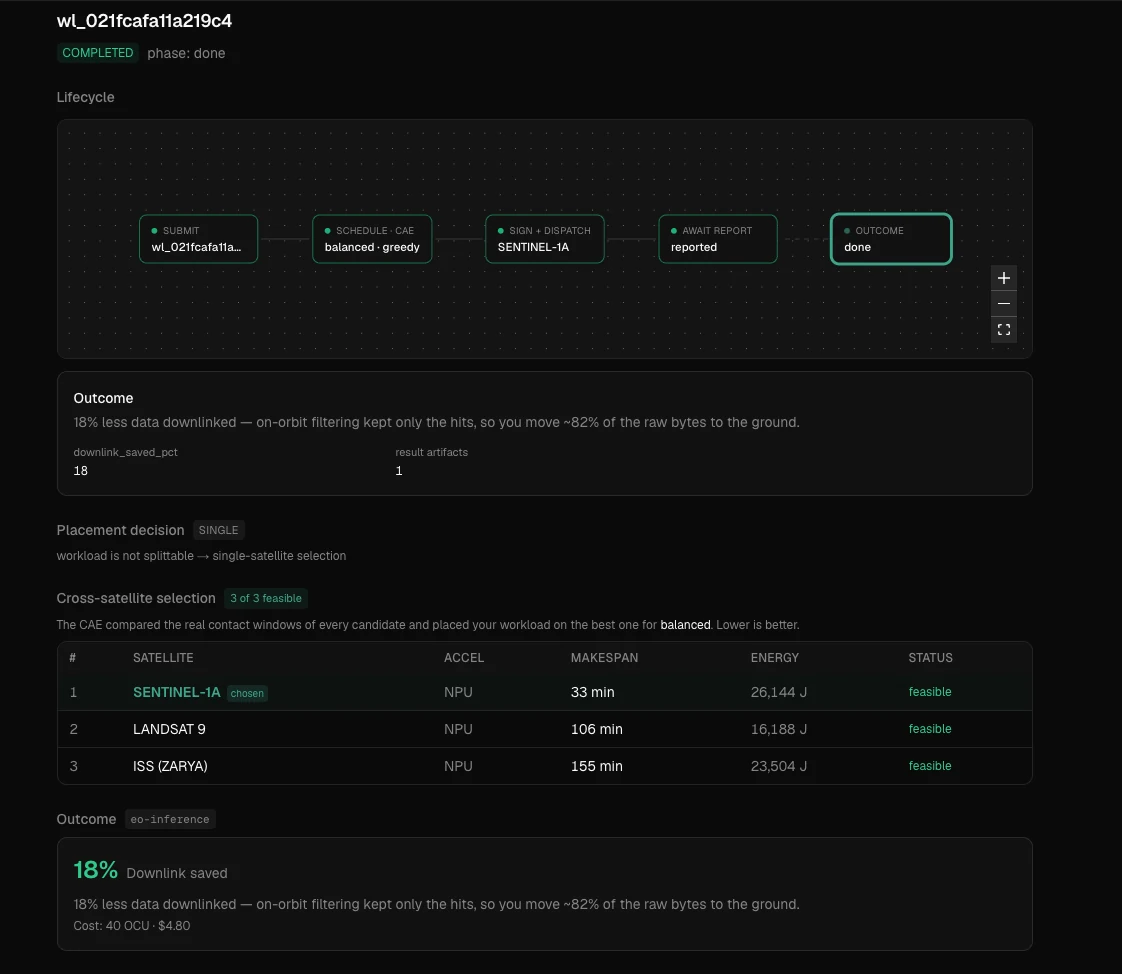
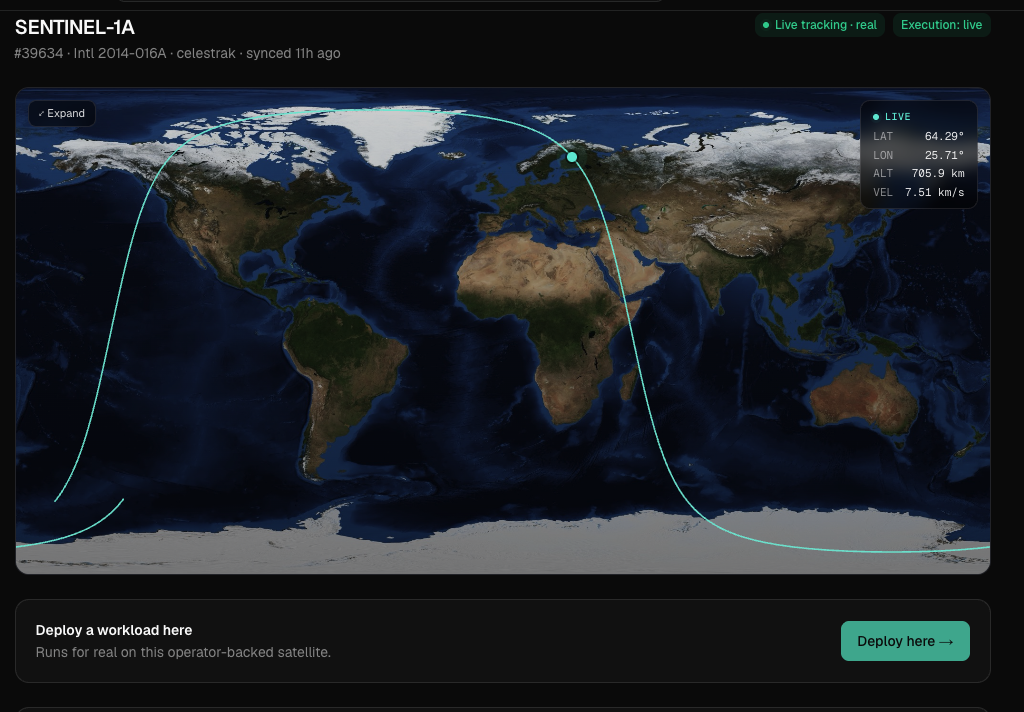
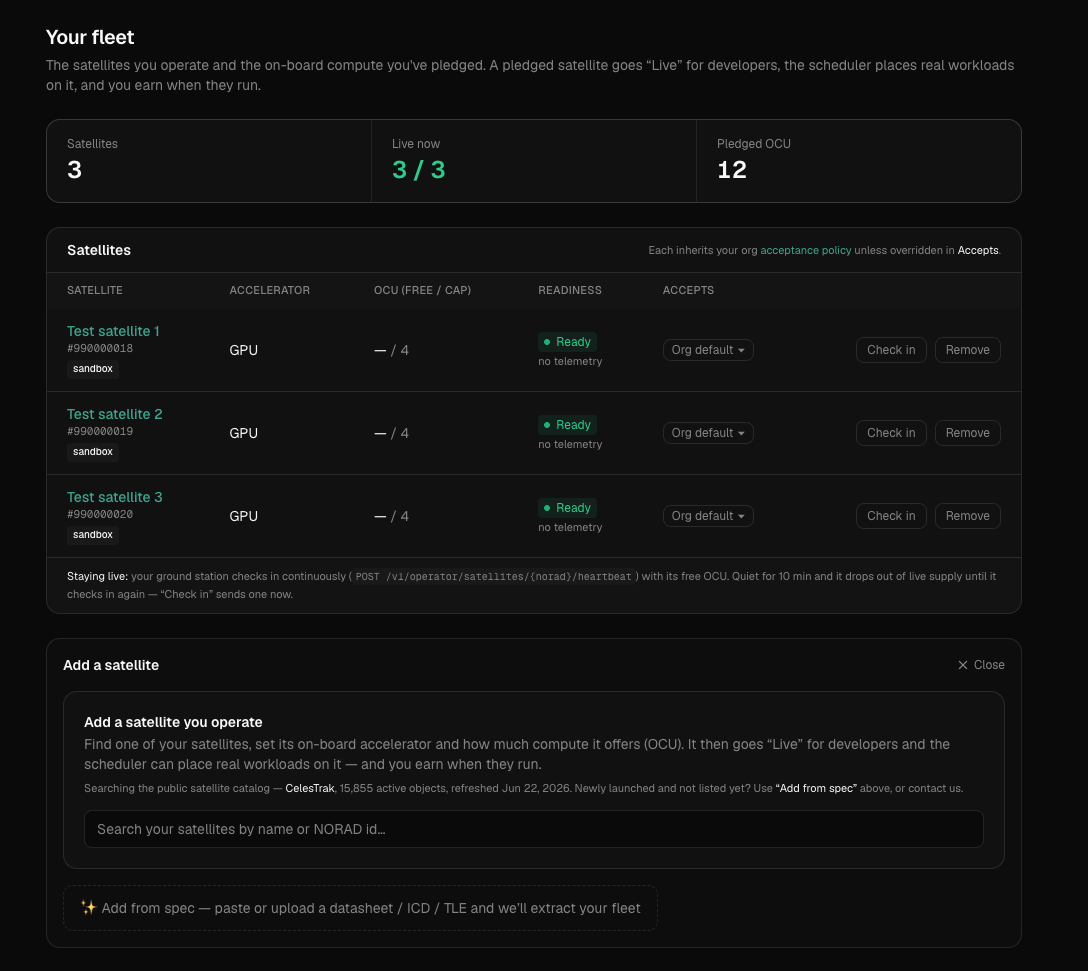
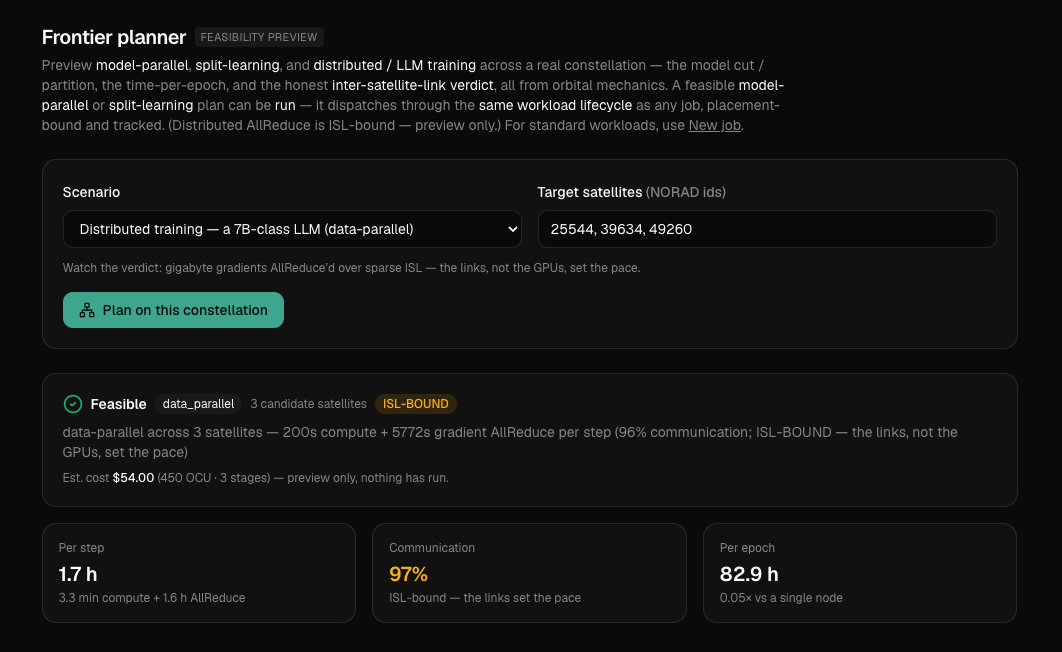
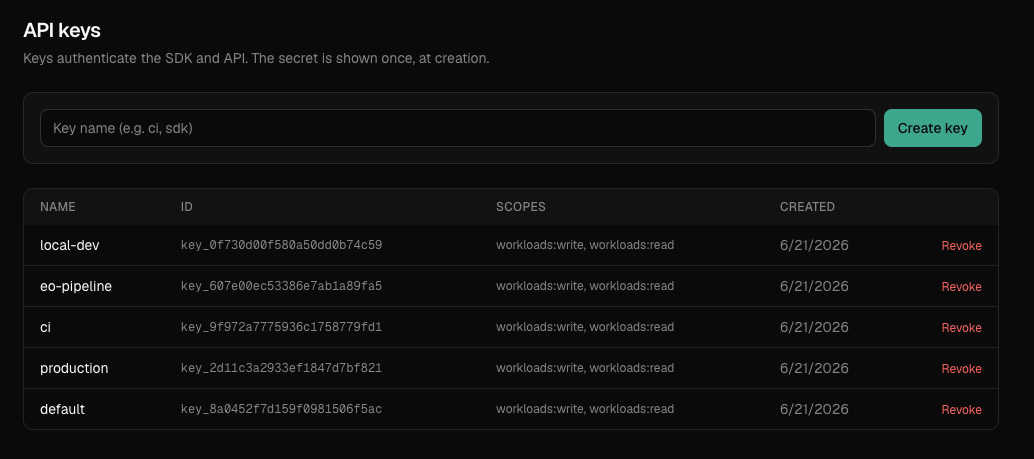
Run a workload in orbit from your terminal.
Bring a program; Rotastellar plans the run under power, thermal, and link budgets, executes it on a node, and returns the result. You never touch a ground segment.
- Submit with the CLI, SDK, or API
- Feasibility, placement & cost before you commit
- Eclipse-aware scheduling, signed execution
Turn your fleet into compute nodes.
Register a satellite as an orbital compute node and run workloads strictly inside its power, thermal, and link budgets - and earn on what you run.
- Onboard & get your satellites verified
- Set an acceptance policy per satellite
- Eclipse-aware pause/resume; live fleet telemetry
Start with the CLI. Build with the SDKs.
The fastest path is the command line; for everything else there are first-class SDKs for Python, Rust, and Node. Point at a workload, and the CAE plans the run while the agent executes it on-orbit.
Plan runs, check feasibility, and track satellites from your existing Python stack.
High-performance orbital planning and tracking - native or compiled to WASM.
Web-native tracking, feasibility, and orbital workload planning.
Latest writing & research
Inside CAE: How a Feasible Plan Gets Built in Under Two Seconds
An engineering view of CAE, the constraint-aware execution planner from Rotastellar. We walk the four-phase pipeline (orbital e...
Read →Compute Isn't a Placement Problem Anymore
Placement was the primitive of the cloud era. Planning against time-varying constraints is the primitive of what comes next. Or...
Read →Introducing the Rotastellar Operator Agent
Rotastellar now has an execution layer. The Operator Agent SDK is a Rust crate that runs on satellites, executes workloads, and...
Read →Where this is going.
Today the platform plans a workload against a real satellite, proves it feasible under real orbital physics, and runs the full agent protocol end to end - software-in-the-loop. We're working with satellite operators to bring that same agent onto real hardware, over live contact windows. Further out, a single job spreads across an entire fleet.
The operator agent runs the full Agent Protocol end to end, software-in-the-loop. We're working with operators to put the same agent on real birds, syncing over RF during contact windows.
Per-operator modeling with Orekit force models and Basilisk 6-DOF spacecraft dynamics, on a dedicated host. Design and dry-run against real physics before you fly.
Put your first workload in orbit.
Tell us what you want to run and the satellite you want to run it on. We'll come back with a feasible plan - or an honest reason it can't be done yet.